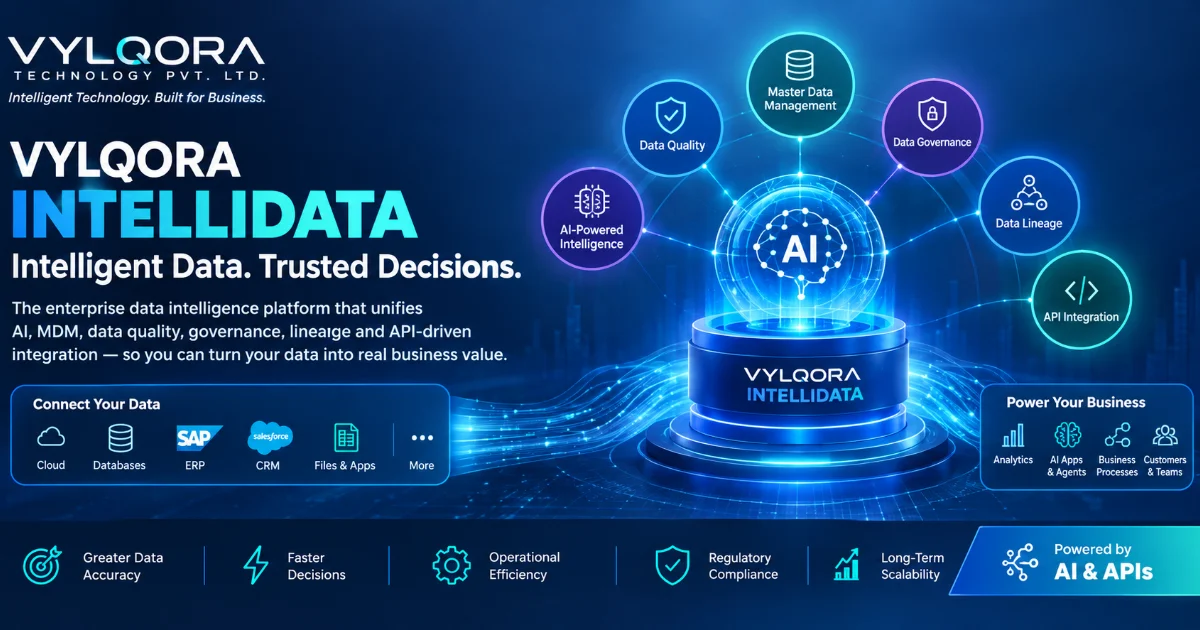
Developed by Vylqora Technology, IntelliData brings together AI, Master Data Management (MDM), Data Quality, Data Governance, Data Lineage, and API-driven integration into a unified enterprise data intelligence platform.
Its vision is straightforward:
Help enterprises move from fragmented data environments to connected, trusted, and intelligence-driven operations.
What Is Vylqora IntelliData?
VYLQORA INTELLIDATA is an enterprise data intelligence platform designed to help organizations manage, understand, improve, govern, and intelligently use their data.
Rather than treating data quality, MDM, governance, integration, and analytics as disconnected activities, IntelliData brings these capabilities together through a connected platform approach.
It is designed to help organizations establish a trusted data foundation while making enterprise data more accessible to business users, technical teams, and AI-powered applications.
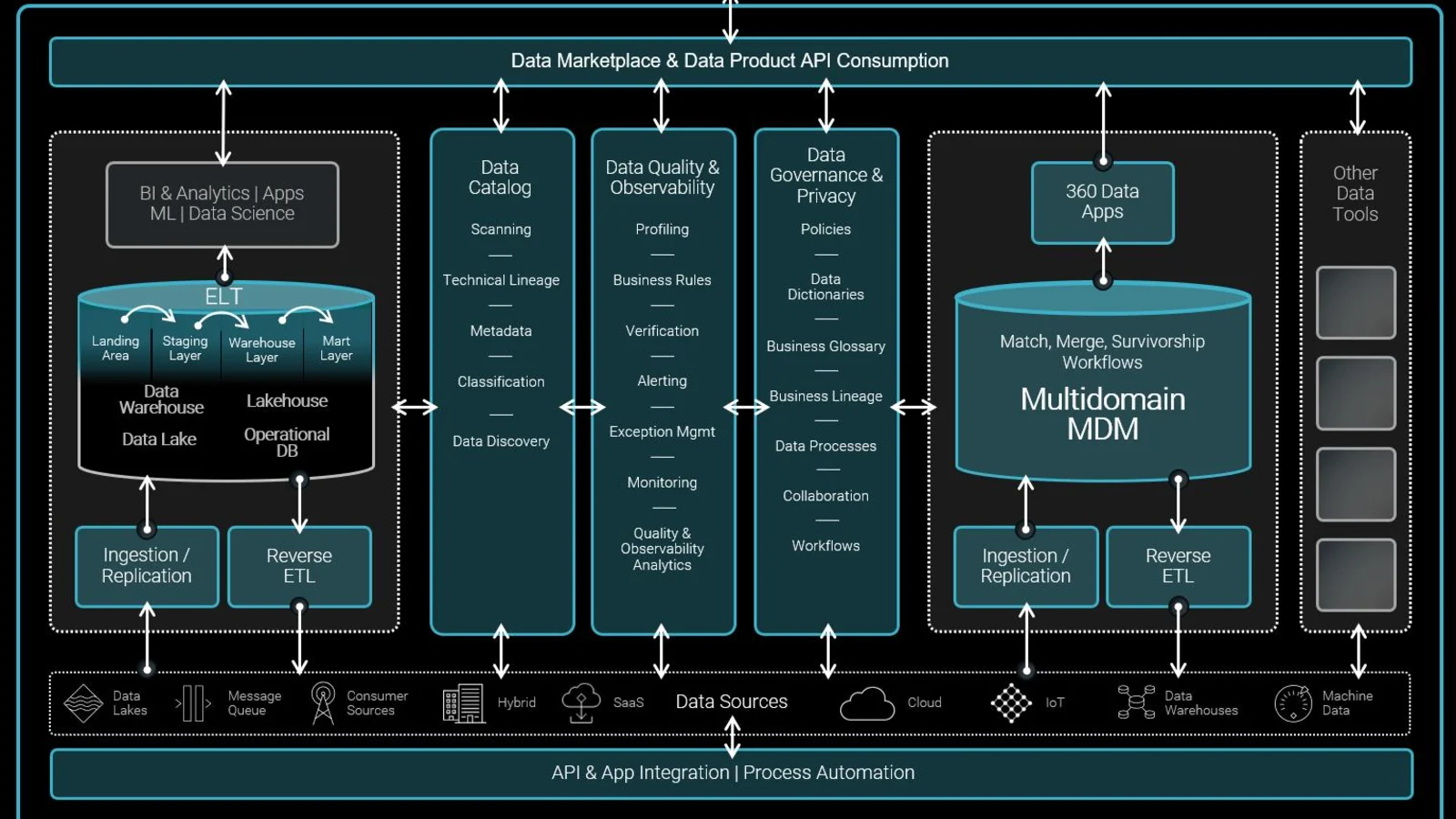
Data Integration: Connect data from multiple enterprise systems through APIs and supported ingestion mechanisms.
Master Data Management: Establish consolidated, consistent views of critical business entities.
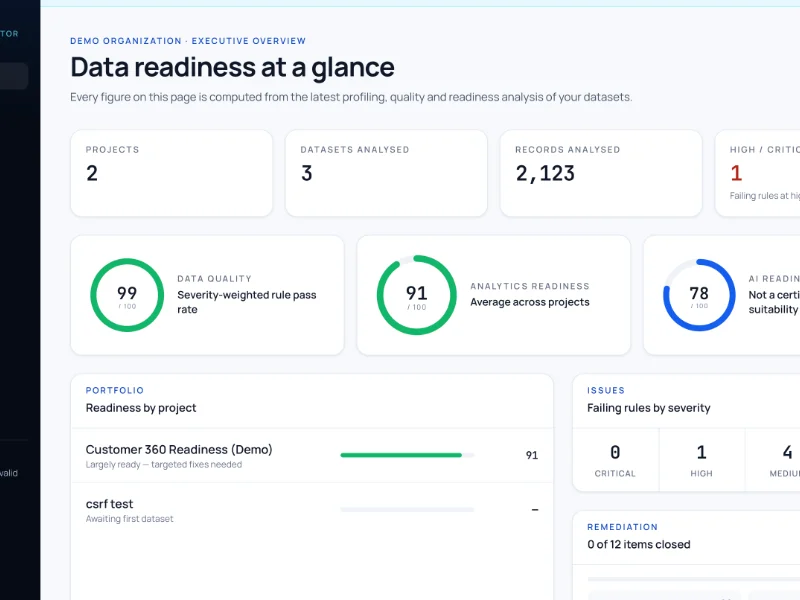
Data Quality: Identify duplicates, inconsistencies, missing information, and potential data issues.
AI-Powered Intelligence: Use AI to accelerate data analysis, surface patterns, and generate actionable insights.
Data Governance: Improve visibility into data ownership, quality standards, and stewardship.
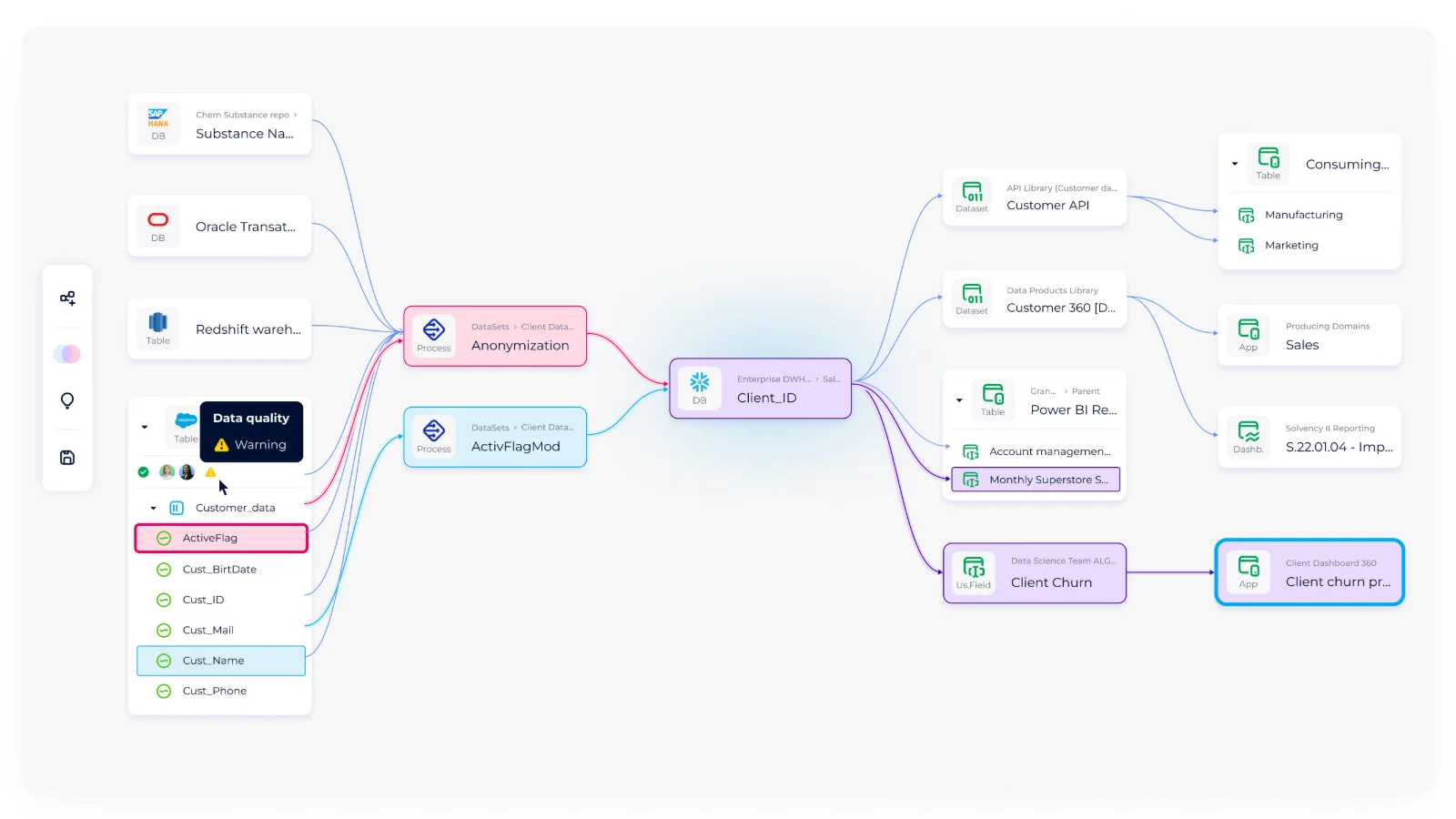
Data Lineage: Understand data origins, movement, transformations, and dependencies.
Enterprise APIs: Enable applications and business processes to consume and exchange data programmatically.
Data Intelligence: Convert complex data observations into insights that support informed decisions.
The objective is not simply to store or process more data. It is to improve how enterprises trust, manage, and extract value from the data they already possess.
AI Capabilities: Moving Beyond Traditional Data Management
Artificial Intelligence is changing how organizations interact with enterprise data. However, AI delivers meaningful business value only when it can work with relevant, reliable, and contextual information.
IntelliData brings AI into the data management lifecycle to help organizations move beyond manual profiling, rule-based validation, and disconnected reporting.
- AI-Powered Data Discovery and Profiling
Understanding an unfamiliar dataset can take considerable time, particularly when organizations manage thousands of tables, files, and data attributes.
IntelliData is designed to use AI-assisted analysis to help identify:
Data structures and attribute patterns.
Potential duplicates and inconsistencies.
Missing or incomplete information.
Relationships between business entities.
Potential data quality concerns.
Patterns that may require further investigation.
This can help data teams accelerate initial assessments and prioritize remediation activities.
- Intelligent Data Quality Assessment
Traditional data quality processes often depend heavily on manually configured rules.
IntelliData aims to complement rule-based validation with AI-assisted intelligence to identify unusual patterns, potential anomalies, and data inconsistencies.
For example, consider an enterprise customer dataset containing:
Different spellings of the same company.
Multiple records with inconsistent addresses.
Missing tax identification details.
Conflicting customer classifications.
Duplicate records originating from different CRM systems.
AI-assisted assessment can help highlight potential issues, explain observed patterns, and support data teams in prioritizing remediation.
Business impact: Reduced manual investigation, improved data visibility, and a more proactive approach to data quality management.
- AI-Assisted Data Intelligence
One of the important objectives of IntelliData is to make enterprise data easier to understand.
Instead of relying exclusively on technical queries and manually generated reports, AI capabilities can help users explore data through contextual questions and obtain meaningful explanations.
Potential use cases include:
Understanding the overall health of a dataset.
Identifying common data quality issues.
Exploring patterns across business entities.
Summarizing profiling results.
Highlighting potential risks and inconsistencies.
Generating actionable recommendations for further investigation.
This approach can help bridge the gap between technical data teams and business stakeholders.
- AI-Assisted Governance and Decision Support
Data governance becomes increasingly complex as enterprise data grows across systems, business units, and geographical locations.
IntelliData aims to support governance activities through intelligent data analysis, metadata understanding, and actionable recommendations.
This can help organizations identify areas requiring ownership, standardization, quality improvement, or further governance controls.
AI should complement governance policies and human oversight—not replace accountability for enterprise data decisions.
API-First Architecture: Connecting Enterprise Data Without Creating More Silos
Enterprise applications cannot operate in isolation. Customer platforms, ERP systems, operational databases, data warehouses, analytics platforms, and AI applications must exchange information reliably.
This is where IntelliData's API capabilities become particularly important.
APIs are not just integration endpoints. They are the foundation for making enterprise data accessible, reusable, and actionable across business ecosystems.
How IntelliData's API Capabilities Deliver Business Value?
- Seamless Enterprise Connectivity
IntelliData is designed around API-driven connectivity to support integration with enterprise applications and data environments.
Potential integration scenarios include:
CRM platforms such as Salesforce.
ERP platforms such as SAP and Oracle.
Enterprise MDM platforms, including Reltio.
Relational databases and cloud data platforms.
Business applications and internal enterprise systems.
External data providers and third-party services.
This architecture enables organizations to connect their existing technology investments rather than creating another isolated data environment.
- API-Based Data Ingestion and Processing
Through API-driven integration, enterprises can establish structured data exchange processes between source systems and IntelliData.
These capabilities are intended to support:
Data ingestion from connected systems.
Structured data exchange using JSON and REST APIs.
Data validation and processing workflows.
Data enrichment and transformation.
Integration with downstream applications.
Reusable data access mechanisms.
The business advantage is flexibility: organizations can integrate data capabilities into their existing workflows without depending entirely on manual file exchanges.
- Enabling Real-Time and Event-Driven Enterprise Use Cases
Modern enterprise applications increasingly require data availability beyond traditional batch-processing windows.
API-based and event-driven integration patterns can support scenarios where changes in one system need to trigger downstream processing or updates.
For example:
A customer record is updated in a CRM system. The integration layer can make that change available for validation, consolidation, and subsequent consumption by connected enterprise applications.
The exact processing frequency and event-handling capabilities depend on the configured integration architecture.
- APIs as an Enabler for AI Applications and Agents
One of the most significant opportunities is connecting enterprise AI applications with governed data capabilities.
IntelliData's API-first approach is intended to make enterprise data intelligence consumable by other applications, including AI-powered workflows and agentic systems.
Consider an enterprise AI agent that needs to investigate customer data quality.
Rather than independently accessing multiple databases, an integrated architecture could allow the agent to:
Request relevant data through authorized APIs.
Retrieve profiling and data quality information.
Understand identified inconsistencies.
Access relevant metadata and governance context.
Present findings to authorized users.
Trigger approved remediation workflows where supported.
This creates a pathway towards AI-enabled enterprise operations, where intelligence is connected to actual business data and processes.
Importantly, enterprise API integrations should operate with appropriate authentication, authorization, access controls, and auditability.
The Enterprise Challenge vs. IntelliData's Approach
- Build a Trusted Foundation for Enterprise AI
Many organizations are investing in generative AI, predictive analytics, and autonomous agents.
However, AI initiatives require more than access to large volumes of information. They need relevant, reliable, and appropriately governed data.
IntelliData addresses this foundational requirement by bringing data quality, governance, lineage, and intelligence into the enterprise data management conversation.
- Reduce Fragmentation Across Data Management Activities
Organizations often implement separate solutions for data profiling, quality management, master data, governance, and analytics.
This can create additional integration complexity and fragmented visibility.
IntelliData's unified platform vision is to bring these activities closer together, helping enterprises establish a more connected data management approach.
- Improve Productivity of Data Teams
Data engineers, architects, analysts, and stewards frequently spend substantial time understanding data structures, investigating inconsistencies, and preparing information for business use.
AI-assisted discovery and analysis can help accelerate these activities while allowing professionals to focus on validation, decision-making, and remediation.
- Make Enterprise Data More Accessible Through APIs
Organizations should not have to rebuild integrations every time a new business application needs access to data insights.
An API-oriented approach provides a foundation for reusable connectivity, application integration, and future AI-driven workflows.
- Strengthen Data Governance and Traceability
As organizations expand their data ecosystems, understanding where data originates, how it changes, and where it is consumed becomes increasingly important.
Data lineage supports this visibility by connecting data sources, transformations, and downstream dependencies.
IntelliData's focus on lineage and governance is intended to help organizations move towards more transparent and accountable data management.
Final Thoughts: Your Data Should Work as Hard as Your Business
Enterprise transformation does not begin with AI alone. It begins with understanding the data that powers business operations.
When information is fragmented, inconsistent, and difficult to trace, organizations struggle to build reliable analytics, scalable integrations, and meaningful AI applications.
VYLQORA INTELLIDATA is built around a different approach: bringing data intelligence, MDM, AI, APIs, quality, governance, and lineage together to address these interconnected challenges.
Because the real value of enterprise data is not how much an organization collects.
It is how confidently that organization can use it.
VYLQORA INTELLIDATA
Intelligent Data. Trusted Decisions.
Transform your enterprise data ecosystem with Vylqora Technology.
Explore how IntelliData can support your organization's data transformation journey.
Connect with Vylqora Technology
Website: www.vylqora.com Email: support@vylqora.com
Intelligent Technology. Built for Business.
Written by VYLQORA. Have a view, or a problem this touches? Start a conversation.